
 By srivaari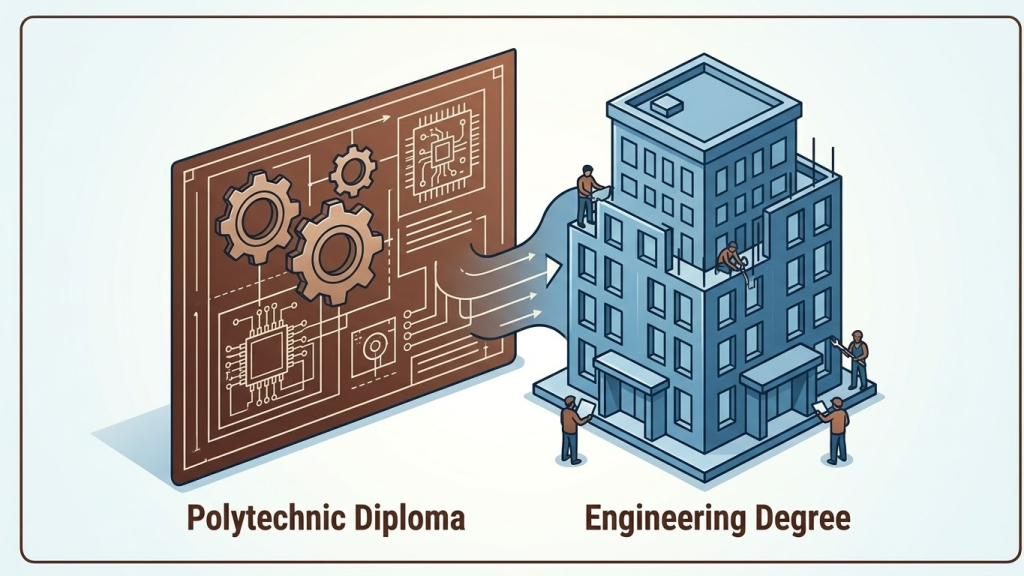
Redefining the Diploma
For a long time, Polytechnic was seen as a "second choice." Today, savvy students and parents are realizing it is actually a strategic advantage. A Diploma in Engineering provides a practical, hands-on foundation that pure classroom learning often misses.
The "Lateral Entry" Secret
One of the biggest benefits of a Polytechnic diploma is the Lateral Entry scheme. After completing a 3-year diploma, students can join the second year of a B.E. or B.Tech degree.
-
Practical Edge: By the time a diploma student reaches the second year of Engineering, they already have three years of lab and workshop experience.
-
Industry Ready: Many industries prefer hiring diploma holders for supervisory roles because of their technical proficiency.
Which Streams are Trending?
-
Mechanical & Civil: Traditional favorites with steady demand in the infrastructure and manufacturing sectors.
-
Electrical & Electronics (EEE): Crucial for the burgeoning Electric Vehicle (EV) industry in India.
-
Computer Engineering: A fast-track way to enter the IT sector.
Making the Right Move
The key to a successful Polytechnic career is choosing an institution with strong industry tie-ups. A well-placed diploma can lead to an immediate job or a smooth transition into higher engineering studies.
1. Is a Polytechnic Diploma equivalent to a 12th-grade certificate? Yes, for most employment and higher education purposes, a 3-year Diploma is considered equivalent to 10+2. In fact, it often gives you a higher technical standing for junior engineer roles in the manufacturing sector.
2. Can I change my branch during Lateral Entry into Engineering? While it is possible in some universities, it is generally recommended to stick to the same or a related branch (e.g., Mechanical Diploma to Mechanical Engineering) to ensure you have the foundational knowledge required for the second-year subjects.
3. What is the average salary for a Diploma holder vs. a Graduate? Entry-level salaries for Diploma holders are slightly lower than B.E. graduates. However, because Diploma holders enter the workforce 2–3 years earlier, they often reach supervisory levels and higher pay scales by the time a traditional graduate is just starting their first job.