
 By srivaari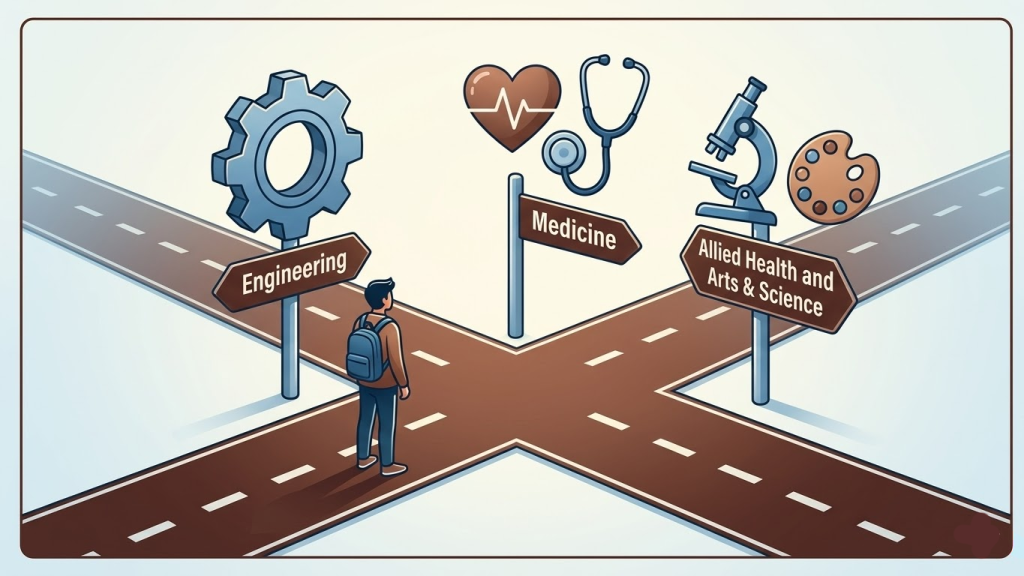
Introduction
The transition from school to college is perhaps the most significant crossroads in a student's life. In India, especially in education-conscious hubs like Tamil Nadu, the pressure to choose "the best" course can be overwhelming. However, "best" is subjective. What works for a neighbor’s child may not work for yours. This guide breaks down how to navigate this maze efficiently.
The Myth of "Only Two Options"
For decades, the narrative has been dominated by Engineering and Medicine. While these remain prestigious and stable careers, the modern economy has opened doors to hundreds of specialized fields.
-
Allied Health Sciences: Fields like B.Sc. Nursing, Radiology, and Optometry are seeing a 20% year-on-year growth in demand.
-
Arts & Science: Specialized degrees in Data Science, Psychology, and Visual Communication are now competing with traditional professional degrees in terms of salary packages.
A Step-by-Step Selection Process
-
Aptitude Over Ambition: Before looking at college rankings, look at the student’s strengths. Does the student enjoy problem-solving (Engineering), biology and service (Medicine), or hands-on technical work (Polytechnic)?
-
Market Demand Research: Look at where the industry is heading. For example, with the rise of AI, traditional IT roles are evolving. Similarly, the healthcare infrastructure boom in India ensures that Allied Health professionals will always be in demand.
-
Financial Planning: Higher education is a long-term investment. Compare the ROI (Return on Investment) of different courses. A Polytechnic diploma followed by lateral entry into Engineering is often a more cost-effective route for many families.
The Role of Professional Guidance
Working with an expert consultant allows you to see the "hidden" details—such as which colleges have the best lab facilities or which universities have the strongest placement cells in Chennai or Coimbatore. Efficiency in choosing the right course now prevents years of career dissatisfaction later.
1. Is it better to follow passion or market trends when choosing a career? Ideally, a balance of both is best. A "passion" without a market demand may lead to financial struggles, while a high-paying job you hate leads to burnout. We recommend identifying your core strengths first, then mapping them to the top 3 growing industries to find the "sweet spot."
2. How do I know if I am suited for a professional degree or a vocational course? Professional degrees (like B.E. or MBBS) are theory-heavy and require long-term academic commitment. Vocational or diploma courses are more "hands-on." If you prefer learning by doing rather than reading textbooks, a technical diploma or an applied science degree might be a better fit.
3. Does the reputation of the college really matter for a first job? Yes, but primarily for the "campus placement" opportunity. Top-tier colleges have better tie-ups with MNCs. However, after your first 2–3 years of work experience, your skills and performance matter far more than the name of the college on your degree.